Money Management for Couples: How to Handle Finances Together
The three models for organizing money as a couple, how to split expenses when you earn different amounts, and the tools that keep the agreement alive past month three.
 SpendlyAI ·
Almost no couple fights about money when there’s money. They fight when one of them finds out late. The purchase nobody mentioned, the subscription that’s been charging for four months, the month that didn’t add up and nobody knows why. The problem is rarely the spending itself — it’s the feeling that you’re watching two different films of the same economy.
This guide covers what actually works for real couples: the three models for organizing money, how to pick yours, the monthly conversation that prevents most of the friction, and what your tool needs to do so the system doesn’t collapse after three weeks.
The three models for handling money as a couple
There’s no correct model. There’s the one you’ll actually sustain. These are the three that get used in practice.
Everything together. One pot. Both incomes go in, all expenses come out. It’s the simplest to understand and the most demanding on trust: any personal purchase is, technically, joint money.
Everything separate. Each of you keeps your own, and shared costs get split — usually in half or by income percentage. It preserves autonomy, but it creates a parallel ledger of who-owes-whom that gets exhausting fast.
Hybrid (what most people use). Three buckets: yours, mine, ours. Each of you contributes an agreed amount to the shared pot, which pays rent, groceries, utilities, and joint goals. Whatever stays in the personal account belongs to that person, no justification required.
| Model | Works well when… | Breaks when… |
|---|---|---|
| Everything together | Incomes are similar and your lives are already deeply intertwined | One of you feels they need permission to spend on themselves |
| Everything separate | Incomes differ a lot, or the relationship is new | Nobody tracks reimbursements and resentment quietly accumulates |
| Hybrid | You want a shared project without giving up autonomy | The contribution is set once and never revisited as incomes change |
If you’re starting out, hybrid is the safest bet: it gives structure without forcing two financial lives to merge into one.
How to split shared expenses when you earn different amounts
Splitting everything in half sounds fair right up until one of you earns double. Then “half” means very different things: it’s 20% of one income and 45% of the other.
The approach that ages best is proportional splitting. Add both net incomes, work out what percentage each person contributes, and apply that same percentage to the shared pot.
With round numbers: if one earns 2,000 and the other 3,000, the total is 5,000 and the shares are 40% and 60%. If shared expenses come to 1,500, one contributes 600 and the other 900. Both are left with the same proportion of free income — which is what actually feels like fairness.
Revisit it whenever something changes: a raise, a job change, a leave. A split that was set three years ago and never touched is a quiet source of resentment.
The twenty-minute monthly conversation
Most couples don’t need to talk about money more. They need to talk about it at the right time, and that time is not mid-argument or when the statement lands.
Book twenty minutes a month, same day every time. The script fits in four questions:
- What happened last month? The numbers, without interpretation. What came in, what went out, where.
- Were there any surprises? Not to assign blame, but to figure out whether it was one-off or about to repeat.
- What’s coming next month? A trip, the annual insurance, someone’s birthday. Anticipated costs don’t wreck a budget.
- Are we still happy with the split? Thirty seconds, usually. But it opens the door to saying so when it stops working.
Making it short and predictable changes the emotional register: money stops being the topic that appears when something’s wrong and becomes routine maintenance, like taking out the bins.
What your tool needs to do
This is where most systems fall apart. The couple agrees on an excellent method, and three weeks later nobody’s logging anything, because logging always falls on the same person and turns into a second job.
A tool that holds up the agreement should do five things:
- Both of you see the same thing, at the same time. If one of you has to export and send a file, the system is already dead. Transactions should appear on the other phone within seconds.
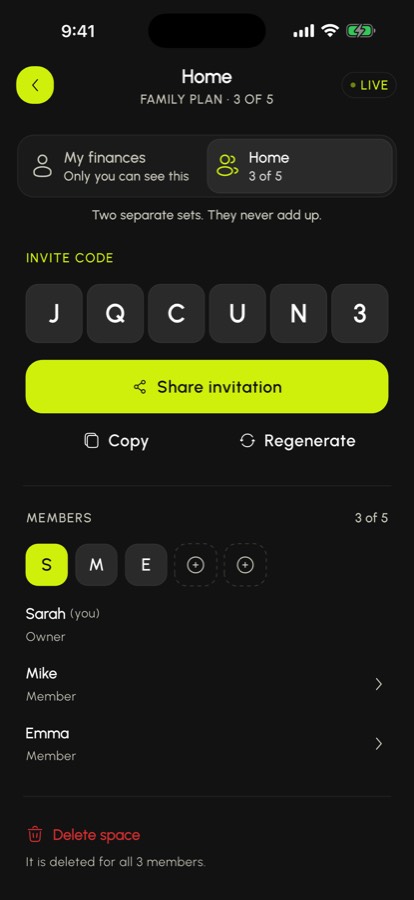
- Shared and personal don’t get mixed. Sharing a joint economy doesn’t mean giving up privacy over your own. They should be two separate sets that never add up together.
- Logging takes seconds, not minutes. By voice, by receipt photo, or straight from the bank notification. If adding an expense takes more than five seconds, it will stop happening.
- Alerts reach both of you. The grocery budget hitting 85% is useful to both people, not just whoever opened the app.
- It works in the country you live in. Plenty of apps only connect to US or European banks. If yours isn’t there, you need an option that doesn’t depend on that connection.
Apps for managing money as a couple
Four options that genuinely work for two people, and what each does well.
SpendlyAI — so logging stops falling on one person
SpendlyAI has shared spaces for two people (Duo plan) or five (Family plan) that sync in real time: what one person logs shows up on the other’s phone instantly. The interesting part is that personal finances stay private — the shared space and your individual money are two separate sets that never add up together.
Logging is where it stands apart: on Android it picks up payments from your bank’s notifications, and on iPhone from Apple Pay or bank SMS, so purchases arrive on their own and you just approve them. You can also dictate to Siri or Google Assistant, send a photo of a receipt, or type “groceries 85” into the chat. It works with no bank connection at all, which matters if you live outside the US or Western Europe.
- Best for: couples where logging always ended up being one person’s chore.
- Price: free to start; the Duo plan adds the shared space and the AI assistant for both of you.
Monarch Money — for full shared dashboards
Monarch became the go-to for households managing money together after Mint shut down. Strong dashboards, shared access, investment tracking, and joint net worth. It’s subscription-based and its bank connections are solid in the US.
- Best for: US couples who want a complete picture of shared wealth.
YNAB — for couples who want a method, not just an app
YNAB makes you give every dollar a job before you spend it. For couples it’s transformative if both people commit, because the method forces the conversation up front instead of the autopsy at month end. The learning curve is real.
- Best for: couples willing to adopt a strict system together.
A shared spreadsheet — for total control
A cloud document costs nothing and adapts to whatever odd arrangement you invent. The problem is the usual one: everything is entered by hand, and with two people that means it gets entered halfway.
- Best for: people who enjoy the manual process and already have the habit.
Side by side
| SpendlyAI | Monarch | YNAB | Spreadsheet | |
|---|---|---|---|---|
| Real-time shared space | Yes | Yes | Limited | No |
| Shared and personal kept separate | Yes | Partly | No | Manual |
| Logs expenses automatically | Yes, notifications, Apple Pay, voice | Bank connection | Bank connection | No |
| Works without a bank connection | Yes | No | Partly | Yes |
| Available outside the US | Yes, 19 languages | Limited | Limited | Yes |
| Free tier | Yes | No | No | Yes |
Our pick: SpendlyAI. It’s the only one on the list that solves the actual failure point for couples — the logging falling on one person — and the only one that works the same whether your bank is in Chicago, Bogotá, or Berlin. Monarch is the stronger choice if you’re both in the US and want investment tracking above everything else, and YNAB wins if what you’re after is a strict method rather than a tool.
Four mistakes that wreck the agreement
- The surprise purchase. Set a threshold — anything above a certain amount gets mentioned first. It isn’t asking permission, it’s avoiding the jolt.
- The single bookkeeper. If one person handles the accounts, the other loses context and, with it, the standing to have an opinion without sounding unfair.
- Budgeting only for monthly costs. Car insurance, annual taxes, and December exist. If they aren’t divided by twelve and set aside monthly, each of those months looks like a failure.
- Having no personal money. Even if you share everything, each person needs an amount they can spend without explaining. It’s cheap and it prevents a lot of resentment.
Frequently asked questions
Should couples have joint or separate accounts?
For most people the hybrid model works best: a joint account for shared expenses and goals, plus a personal account each. It gives transparency where it’s needed and autonomy where that’s needed too.
How do we split expenses if we earn very different amounts?
Split proportionally to income rather than in half. Add both net incomes, calculate each person’s percentage, and apply that percentage to the shared expenses. That leaves both of you with the same proportion of free money.
What app is best for couples managing money together?
You need one that syncs in real time across both phones and keeps shared money separate from personal money. SpendlyAI has shared spaces with that separation plus automatic logging from bank notifications; Monarch Money works well if you’re in the US and want full dashboards; YNAB is the pick if you want to adopt a strict method.
How often should we review our finances together?
Once a month, twenty minutes, same day each time. More often gets tiring, and less often turns every review into a long argument about things you can no longer change.
What if one of us spends much more than the other?
Measure before you negotiate. The perception that someone “spends too much” is often built on two or three memorable purchases rather than the actual total. With the numbers in front of you the conversation changes tone, and it usually resolves by adjusting each person’s personal allowance rather than banning categories.
The bottom line
Managing money as a couple isn’t about finding the perfect method — it’s about finding one that both of you can sustain without it becoming one person’s job. Pick a model (probably hybrid), split proportionally to income, book twenty minutes a month, and use a tool where both of you see the same thing without anyone typing it in. If you want to go deeper on the mechanics of budgeting itself, start with how to make a budget and the 50/30/20 rule.